

Turning blind sedation into precision medicine.
Backed by £2.2 million in equity investment and scientific grants to date, Somnus Scientific has developed the world's only propofol antibody, and with it, the world's first point-of-care blood propofol measurement system.
The problems are real. The evidence is documented. The solution is coming, starting in UK ICUs in 2027
We publish a quarterly updates for investors and partners. Add your email to stay informed.
Investment Information
Current raise is closed at a £9 million pre-money valuation
What is Propofol?
Propofol is the default sedative in modern hospitals. It is used to keep patients calm and comfortable in intensive care, and to enable procedures such as colonoscopy and surgery.
It is one of the most administered drugs in modern hospitals, used in ICUs every day, and in procedural settings millions of times each year worldwide.
The Problem
Propofol is one of the most widely used drugs in modern medicine, infused continuously in intensive care, administered millions of times a year in procedural sedation. Yet at the bedside, its blood concentration cannot be measured. Every dose is estimated, not measured.
Why this matters
In the ICU, unmeasured sedation means many patients receive more propofol than they need. Over-sedation is a modifiable risk factor for delirium, experienced by up to 80% of ventilated patients, and for ventilator-associated pneumonia, the most common hospital-acquired infection in ventilated patients. Both prolong ventilation, extend ICU stay, and cast a shadow over recovery long after discharge.
In procedural care, the same gap works in reverse: because residual drug levels are unknown, discharge is conservative by default, slowing recovery units and restricting patients for a full day after routine procedures.
No other drug this powerful, used this widely, is dosed without measurement. The result is avoidable harm, avoidable cost, and avoidable pressure on the most expensive beds in the hospital.
The Solution
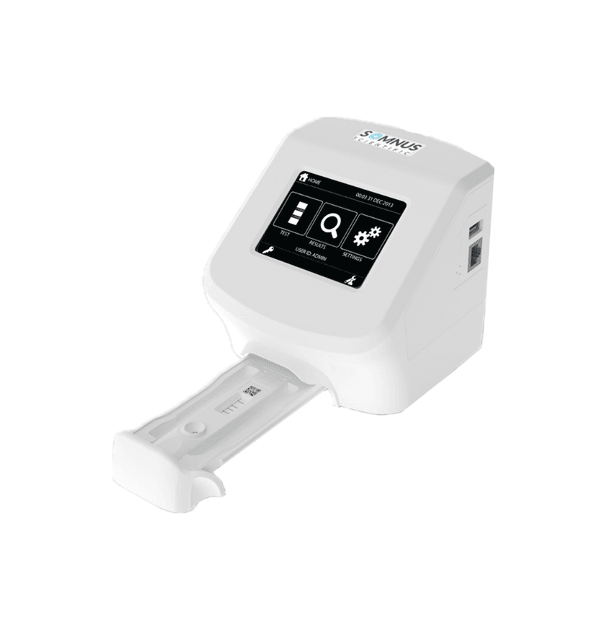
Somnus has developed the first rapid, point-of-care system to measure blood propofol concentration at the bedside.
ProSed® delivers a quantitative result from a drop of blood in minutes, enabling clinicians to personalise sedation in real time.
ProTIVA™, in development, will provide continuous propofol monitoring during anaesthesia, enabling fully controlled, gas-free sedation.
Together, they transform propofol from an estimated therapy into a measurable, controllable one.
Measurement turns sedation from judgement into precision.
Why now?
For four decades, clinicians have managed propofol sedation without being able to measure it, relying on observation, scoring systems, and hard-won judgement. They have done remarkable work with incomplete information.
But the information gap itself is no longer tolerable, and critical care knows it.
Clinical guidelines now call for light, personalised sedation. Research is revealing the long shadow of over-sedation: delirium, cognitive impairment, PTSD that persists years after discharge. ICU nurses consistently identify sedation management as a major source of stress and burnout. The standard of care is moving, but the tools haven't moved with it.
The profession has now said so itself. In July 2026 the Intensive Care Society, with the James Lind Alliance and the NIHR, published the UK's Top 10 research priorities for adult intensive care, drawn from more than 1,500 questions submitted by patients, relatives and clinicians. Preventing and treating delirium is listed first. Phasing out heavy sedation is named as an outdated practice to retire.
Clinical ambition, patient outcomes, and staff wellbeing are all pointing in the same direction. What's missing is measurement.
ProSed® arrives at exactly that moment. From 2027, the gap between what clinicians are asked to achieve and what they can actually see begins to close.
What is the market size?
ProSed® addresses a global, recurring need: propofol measurement embedded in everyday clinical workflows.
ICU sedation: ~£2.5bn global. 20 million ICU patients require sedation every year. ProSed® testing integrates into existing daily blood sampling for every ventilated, sedated patient.
Procedural sedation: ~£1bn global. In the US alone, 19 million colonoscopies are performed annually, 95% under sedation. A single ProSed® test supports objective, timely discharge.
Together, a ~£3.5bn global opportunity for point-of-care propofol measurement, beginning in UK ICUs in 2027, followed by the US.
What is the business model?
Somnus operates a high-margin diagnostic consumables model: ProSed® readers placed in clinical units, generating recurring revenue through single-use test cartridges, one for every blood propofol measurement.
Because testing is embedded in daily clinical protocols rather than discretionary use, revenue is recurring, predictable, and scales directly with clinical activity.
The initial focus is ICU sedation, followed by expansion into procedural sedation, where each stage broadens utilisation and deepens clinical integration.
Distribution is delivered through specialist in-territory partners. These are established critical care suppliers with existing hospital relationships, keeping Somnus capital-efficient while scaling internationally.
Beyond the core business, the world's only propofol antibody creates licensing opportunities in laboratory diagnostics and drug screening. This optionality sits outside current forecasts.
Traction & Validation
Somnus has completed a multi-year R&D programme and established proprietary propofol measurement technology, moving from a world-first scientific breakthrough to a functional, validated system.
Key achievements to date:
- World-first recombinant monoclonal antibody to propofol
- Functional ProSed® system, validated against the laboratory gold standard, with a complete cartridge and reader workflow
- Quantitative testing completed using human blood samples
- ISO 13485-certified Quality Management System, held since 2024
- UK and US regulatory strategies defined with specialist external advisors
- NHS clinical study sites established at leading UK hospitals
- Grant funding and government-backed innovation programmes in the UK and US
- Distribution partnerships established across the UK and international markets
Protected by design
The technology is protected by three distinct patent families, 100% owned by Somnus, with global coverage:
- The propofol immunoassay. Covering the novel immunogen, the antibody, its method of preparation and molecular sequence, and the immunoassay built on it. Published and proceeding to grant.
- Enhanced detection. Covering proprietary methods for enhancing propofol detection. Published and proceeding to grant.
- Electrochemical sensing. UK patent granted, with international applications published in Europe, the USA, China and Japan.
The portfolio spans design, method and utility applications, supported by a regularly assessed Freedom to Operate position and registered trademarks including the ProSed® brand.
The antibody itself is the moat. Propofol is not naturally antigenic, and creating a usable antibody to it was the core scientific breakthrough. Somnus holds the world's only propofol antibody, and every quantitative propofol immunoassay depends on one.
Somnus is now focused on completing analytical validation, regulatory submission, and first commercial deployment.
What is the regulatory pathway?
ProSed® follows a UK-first regulatory strategy, using the UK's defined route to market for in vitro diagnostics before extending to the US and Europe.
United Kingdom (launch 2027)
- ISO 13485-certified Quality Management System, held since 2024
- Regulatory route defined under the UK medical device framework, supported by specialist UK regulatory advisors
- Technical file in preparation
- Research use launch planned for late 2026, generating real-world experience in NHS settings ahead of full clinical launch in 2027
United States (launch 2028)
- FDA engagement underway, with the regulatory strategy developed alongside specialist US advisors
- Submission pathway defined, targeting clearance ahead of US launch in 2028
- Leading US clinical centres engaged to support evaluation and early adoption
Somnus works with dedicated regulatory partners in both markets: Regulatus in the UK and RQM+ in the US.
Financial Outlook
Five-Year Base Case
The rollout is deliberately sequenced: UK first in 2027, the USA in 2028, major European markets in 2029, and ANZ, Canada, China and Japan in 2030. Each market follows its own adoption curve grounded in observed uptake patterns for supported medical technologies, with no market assumed to reach full penetration.
- FY28: ~£1.0m revenue (UK launch, ~2% UK penetration)
- FY29: ~£6.8m revenue, EBITDA positive (US entry, UK at 3%)
- FY30: ~£20.1m revenue, ~£15.8m EBITDA (European entry, UK at 7%)
- FY31: ~£41.9m revenue, ~£34.0m EBITDA (ANZ, Canada, China and Japan entry, UK at 12%)
- FY32: ~£85.4m revenue, ~£70.5m EBITDA (all launch markets live, UK at 20%)
Even at the end of Year 5, the base case assumes barely 2% of the total addressable test volume across launch markets has been captured, with the UK, the most mature market, at just one fifth of its terminal adoption ceiling of 45%. The years beyond FY32 are not a new story; they are the same curves continuing to run.
How much are you raising?
Somnus is raising £2 million to bridge the company to first UK commercial sales and US launch readiness.
- EIS eligible for qualifying UK investors
- Priced at the current share price, unchanged from the last round
- First close in December 2026, with a second tranche opening in January 2027
- A portion of the round is already committed from existing shareholders
Use of funds: completing UK regulatory clearance, first commercial ICU deployments, and generation of real-world clinical and economic evidence. This round funds commercialisation, not speculative science.
Detailed terms and the full data room are available to qualifying investors.
What does this round deliver?
This round takes ProSed® from validated technology to revenue-generating product, funding every step between regulatory clearance and the first commercial ICU deployments, and the facility that underpins them.
- Our own laboratory at Future Space, Bristol (opening late 2026): a purpose-built facility bringing ProSed® development, testing and R&D, next to the Health Tech Hub at UWE Bristol
- UK regulatory clearance under the UK IVD framework
- Research use launch in NHS settings (late 2026), building real-world experience ahead of commercial launch
- First commercial UK ICU deployments (April 2027)
- Real-world clinical and economic evidence from early adopter sites
- Distributor rollout
- US FDA submission progressed, positioning for US launch in 2028
What are the key risks?
1. Analytical Validation
Risk: Achieving precise quantitative detection of a hydrophobic molecule like propofol at point-of-care is technically demanding.
Mitigation:
- Proprietary monoclonal antibody and immunoassay platform developed in-house
- Parallel electrochemical and immunoassay sensor pathways, reducing single-platform dependency
- Validation against laboratory gold standards (LC-MS/HPLC)
- Lot-to-lot reproducibility and stability testing built into the development plan
Status: ISO 13485 quality system in place since 2024. Independent laboratory validation underway. Granted UK patent on the core sensor platform, within a multi-family IP estate protecting assay, displacer and sensor technologies.
2. Regulatory Timing
Risk: UK and US regulatory timelines could extend, impacting launch and revenue timing.
Mitigation:
- UK-first strategy using the UK's defined IVD route to reach the market earliest
- Research use launch (late 2026) generating real-world experience ahead of full commercial launch
- Specialist regulatory advisors retained in both markets: Regulatus (UK) and RQM+ (US)
- Documentation aligned to FDA-grade standards from inception
Status: ISO 13485 certified. UK pathway defined with technical file in preparation. FDA engagement underway with the US submission pathway defined, targeting launch in 2028.
3. Hospital Procurement Cycles
Risk: Hospital purchasing processes are multi-stakeholder, evidence-heavy, and slow.
Mitigation:
- KOL-led entry into early adopter sites
- Structured rollout model: supported test-drive, local protocol summit, SOP adoption
- Health-economic modelling built at individual ICU level in the UK and adapted for US systems
- Distributor partnerships in key territories to accelerate local access
Status: Clinical champions embedded. Distribution partners established in the UK and internationally. Benefit model developed for every ICU in England. Early engagement with major strategic MedTech players.
4. Adoption Speed
Risk: Even after approval, uptake may be gradual if clinical practice does not change.
Mitigation:
- Positioning ProSed® within established ICU sedation guidelines and the ABCDEF framework
- Evidence generation focused on measurable endpoints: ventilation duration, ICU length of stay, delirium incidence, discharge timing
- Peer-reviewed publication and conference dissemination
- Building a community of practice around precision sedation
Status: Prospective outcome datasets planned. Conference presentations delivered across the UK, US, Brazil and Canada. Publications in peer-reviewed journals. Clear expansion pathway from ICU into procedural sedation.
5. Clinical Outcomes Evidence
Risk: The health-economic case currently rests on literature-based assumptions about the effect of precision sedation. ProSed®-specific outcomes data does not yet exist.
Mitigation:
- First commercial deployments structured to generate real-world outcomes data from launch
- Evidence generation designed around the endpoints that drive the economic model
- Research use phase building clinical familiarity and baseline data ahead of commercial launch
Status: Evidence generation is a core use of funds for this round. Early adopter sites selected with data capture in mind.
What is the exit strategy?
Somnus is being built for acquisition. The company is creating a new measurement category that sits at the intersection of three consolidating markets: diagnostics, ICU monitoring, and anaesthesia systems.
The lateral flow assay market is dominated by global players who grow through acquisition, and protocol-embedded consumables businesses, with recurring revenue built into daily clinical workflows, are precisely the assets they compete for. The world's only propofol antibody cannot be replicated by a competitor; it can only be bought.
Natural acquirers include:
- Global diagnostics leaders seeking novel, defensible assay platforms
- Anaesthesia and patient-monitoring majors extending into measurement
- MedTech strategics building protocol-embedded consumables portfolios
Investor Newsletter
To request the full investment memorandum, financial model, or data room access, please drop your name and email and we will contact you:
Important Investment Information
This website contains information about Somnus Scientific Limited that is directed exclusively at professional investors.
In the United Kingdom, this information is intended only for investment professionals and high net worth entities within the meaning of the Financial Services and Markets Act 2000 (Financial Promotion) Order 2005 (as amended), or other persons to whom it may lawfully be communicated.
In the United States, any investment-related information is intended solely for persons who qualify as “Accredited Investors” under Regulation D of the Securities Act of 1933.
Nothing on this website constitutes an offer to sell or a solicitation of an offer to buy any securities. Any investment will be made only on the basis of formal investment documentation provided separately.
Investments in early-stage medical technology companies are high risk. Capital is at risk and investors may lose some or all of their investment. Prospective investors should seek independent professional advice before making any investment decision.